Standing vs. Sitting: Does It Change How Well You Empty?
What the position debate is actually about, why sitting can help some men finish more completely, and how to decide without turning it into an identity crisis.
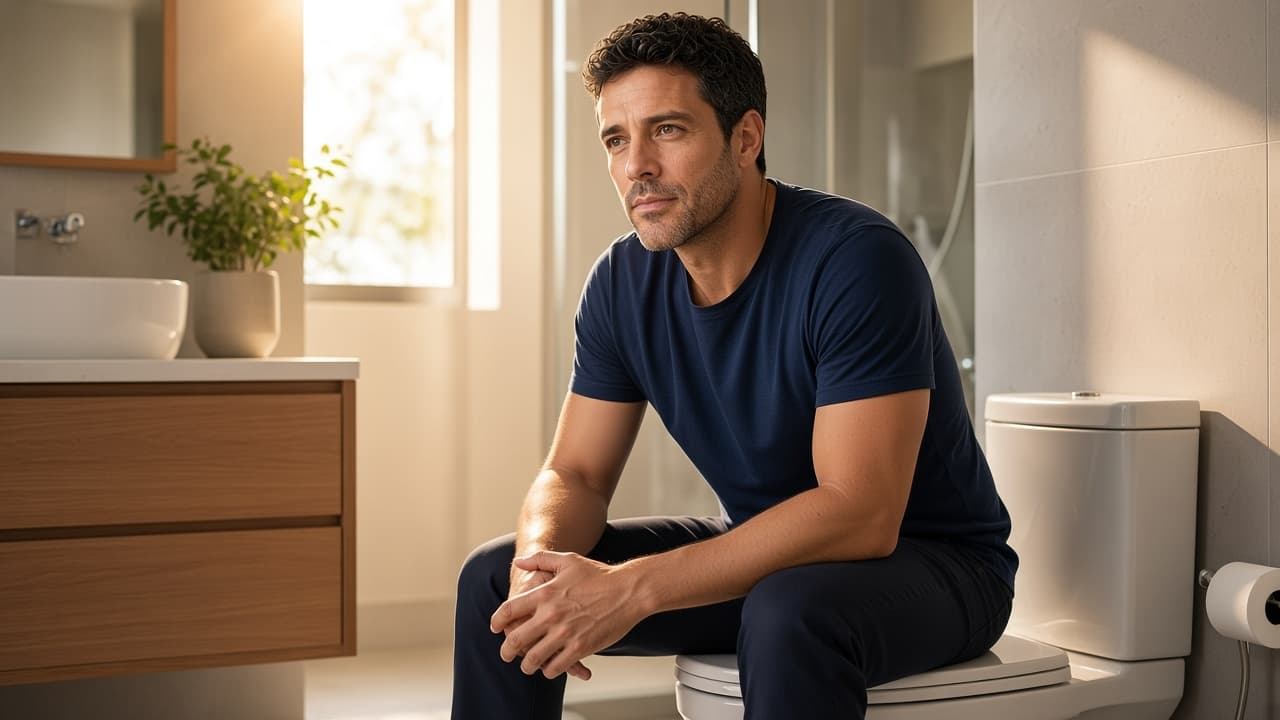
This question generates more heat than it deserves. Stripped of the culture-war framing, it is a fairly narrow mechanical question: does position change how completely you empty, and does that affect after-dribble?
Educational information only, not medical advice. If you have a weak stream, straining, or a persistent feeling of not emptying, please speak with a qualified healthcare professional rather than adjusting your posture and hoping.
What position actually changes
Three things:
- Pelvic floor relaxation. Sitting tends to relax the pelvic floor more completely than standing. A relaxed floor lets the urethra open more fully.
- The angle of the curve. The bulbar urethra — the dip described in why drops come out after peeing — sits at a different angle when you are seated, which changes how it drains.
- How long you stay. Sitting removes the social pressure to be quick. A large share of the benefit men attribute to sitting is really the benefit of not rushing.
That last point matters. Before concluding that sitting works better, check whether you are simply giving it more time — the effect covered in how long to wait before zipping up.
What the evidence broadly suggests
Research in this area is modest and mostly focused on men with existing urinary difficulties, particularly those with prostate enlargement. The general pattern reported is that for men with lower urinary tract symptoms, sitting is associated with somewhat better emptying measures. For men without symptoms, the difference tends to be small or unclear.
Which is a fair summary of most of life: if the system is working normally, posture is a minor variable. If it is not, posture is one of several things that can help at the margin.
The practical answer
You do not have to pick a side. Consider it situational:
| Situation | Reasonable choice |
|---|---|
| At home, no rush | Either. Sitting makes the full technique easier to perform. |
| First thing in the morning | Sitting, if you find the stream slower to start. |
| Public urinal | Standing, obviously. Use the short version of the technique. |
| Any time you feel you have not emptied | Sitting, unhurried — and mention the feeling to a clinician if it persists. |
Standing well is a real option
If you prefer standing, posture still helps. Standing tall with hips slightly forward, rather than leaning back or hunching over, changes the angle of the curve in a useful direction. It costs nothing and no one can tell you are doing it.
What position will not do
It will not empty the dip on its own. Whatever posture you adopt, gravity does not clear a low point in a tube — that requires either time or deliberate pressure. Position is a helpful variable, not a solution.
The deliberate part — where to press, in which direction, and in what order — is the subject of the guide.